
Betterment and Apportionment in Tenancy Deposits
Updated: Aug 29

What is Betterment in Tenancy Deposits?
Betterme pnt is a keyrinciple in tenancy deposit disputes.
Betterment prevents a landlord from being left in a better position at the end of a tenancy than they were at the start.
A tenant may be responsible for damage or deterioration beyond fair wear and tear, but not for funding full replacement where an item has already been partly used, aged or depreciated.
This principle is widely reflected throughout tenancy deposit adjudication and broader industry guidance, including guidance published by the Tenancy Deposit Scheme, mydeposits, Deposit Protection Service and Propertymark.
Why Betterment Matters
Without fair apportionment:
tenants may be unfairly overcharged.
claims may be reduced at adjudication.
landlords may unintentionally seek new-for-old replacement costs.
The aim is to achieve a fair and evidence-based outcome supported by the tenancy agreement, inventory evidence and the individual circumstances of the tenancy.
The Importance of a Detailed Check-In Inventory
Betterment cannot be assessed properly without a clear evidential baseline.
A detailed check-in inventory should record:
condition.
cleanliness.
age (where known).
specification and quality.
existing wear or defects.
Without this, it becomes significantly more difficult to demonstrate:
deterioration during the tenancy.
whether damage exceeds fair wear and tear.
the remaining lifespan of an item.
the extent of any loss.
Independent inventory reporting therefore remains an important part of evidencing tenancy condition throughout the tenancy lifecycle.
Separating Wear and Tear, Cleaning and Damage
One of the most common causes of dispute is the failure to distinguish between fair wear and tear, cleaning and damage.
Fair Wear and Tear
Fair wear and tear refers to deterioration arising through normal day-to-day use over time and would not normally give rise to a tenant claim.
Factors commonly considered include:
tenancy length.
number and type of occupants.
age and quality of the item.
expected usage.
location within the property.
Cleaning
Cleaning is separate from fair wear and tear.
The property should normally be returned in accordance with the standard of cleanliness recorded at check-in and the obligations contained within the tenancy agreement.
Supporting evidence may include:
the inventory report.
photographic evidence.
contractor invoices or cleaning receipts where available.
Damage or Neglect
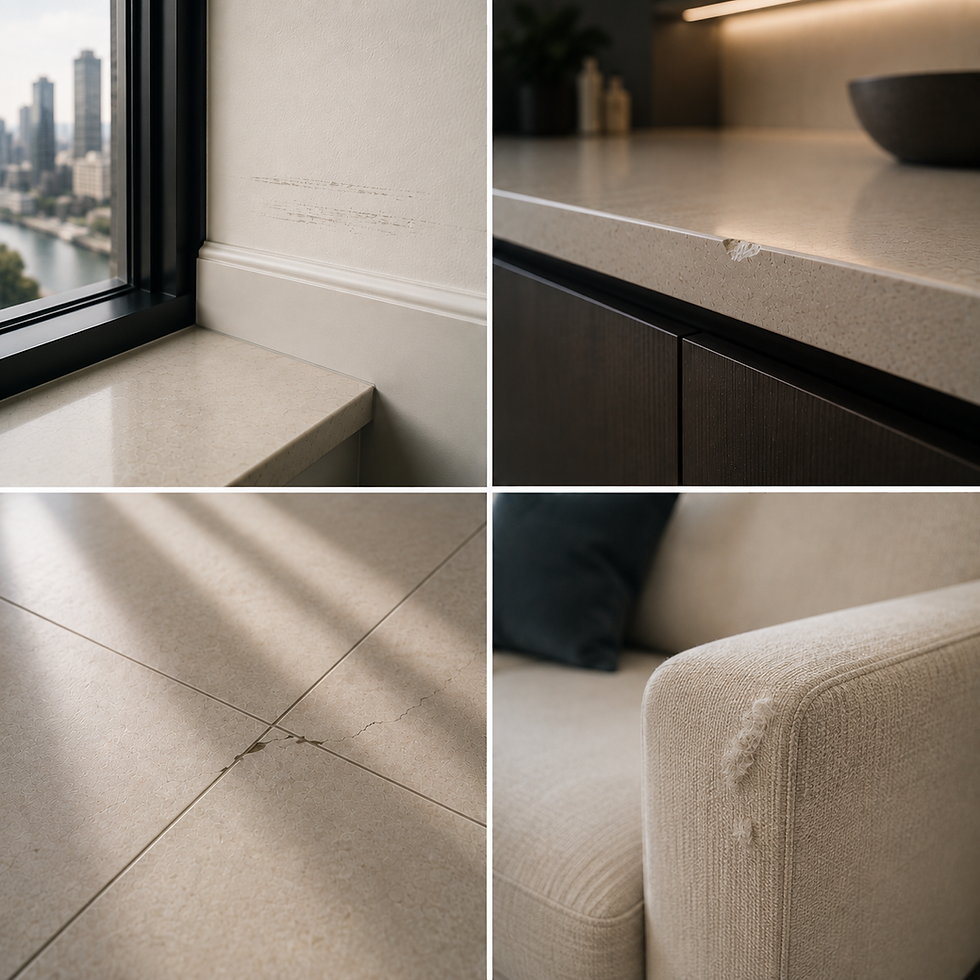
Damage occurs where deterioration goes beyond ordinary use.
Examples may include:
burns.
staining.
breakages.
unauthorised alterations.
misuse or neglect.
Where damage is established, the issue becomes one of fair apportionment rather than automatic replacement cost.
A Practical Approach to Fair Apportionment
Where replacement is required due to tenant damage, deposit schemes will normally consider fair apportionment rather than automatic full replacement cost.
A practical approach is to consider:
replacement cost.
age at the start of tenancy.
expected lifespan.
remaining useful lifespan.
For example:
Item | Replacement Cost | Expected Lifespan | Age at Start of Tenancy | Remaining Lifespan | Fair Contribution |
Living room carpet | £900 | 8 years | 3 years | 5 years | £562.50 |
Replacement cost x Remaining lifespan ÷ Expected lifespan
This approach helps demonstrate a fair and proportionate contribution while avoiding betterment.
However, these calculations should only be treated as guidance rather than fixed rules.
Adjudicators may also consider:
quality and specification.
condition at check-in.
tenancy length.
occupancy levels.
level of use.
whether deterioration resulted from ordinary use or avoidable damage.
The same principles may also apply to decorative finishes, furnishings, upholstery, curtains, blinds and other contents where deterioration exceeds fair wear and tear.
Damage Does Not Always Mean Depreciation
Whilst betterment and fair apportionment are important principles, this does not necessarily mean that every claim for damage must automatically be reduced according to age or expected lifespan.
Where a tenant causes specific and avoidable damage to an item that would otherwise have remained serviceable, the landlord may suffer a direct loss beyond normal depreciation.
Examples may include:
broken sanitary fittings.
damaged furniture.
burns.
chemical damage.
permanent staining.
broken fixtures or fittings.
other defects requiring repair or replacement.
Similarly, where professional cleaning or repair is undertaken but fails to restore an item fully to its previous condition, a residual loss may remain. In such circumstances, the landlord's claim may extend beyond the cost of the remedial work itself, provided the remaining defect and resulting loss can be evidenced.
Each case should be assessed on its own merits, taking into account the age, condition and quality of the item together with the nature and extent of the damage. The overriding principle remains that the landlord should be restored, as far as reasonably possible, to the position they would have been in had the damage not occurred, without being placed in a better position than before the tenancy.
Delayed Reporting and Escalation of Damage
Most tenancy agreements require tenants to take reasonable care of the property, act in a tenant like manner and report maintenance issues, defects or damage promptly once identified.
Where a maintenance issue or defect becomes apparent during the tenancy, failure to report the issue within a reasonable timeframe may result in further deterioration and may be relevant when assessing responsibility and any proposed apportionment.
Prompt reporting may help prevent avoidable deterioration and consequential damage.
Examples may include:
water ingress left unreported.
leaks causing progressive damage.
defective sealant allowing further deterioration.
damage worsening through continued use after the issue became apparent.
Assessment will depend on the individual circumstances, tenancy obligations, inventory evidence, contractor findings and supporting documentation available at the time of dispute review or adjudication.
Lifespan Is Not a Fixed Rule
Expected lifespan should always be treated as guidance rather than a rigid timetable.
The useful lifespan of carpets, decorative finishes, fixtures and other items may vary depending on:
quality and specification.
room location.
level of use.
occupancy levels.
maintenance and care.
For example, a stairs or hallway carpet may reasonably deteriorate faster than a lightly used bedroom carpet due to heavier foot traffic.
Similarly, decorative finishes such as standard emulsion paintwork may commonly require cyclical redecoration within approximately 3–5 years depending on occupancy levels, room usage and overall wear.
Each case should therefore be assessed on its own evidence and circumstances.
Interim Inspections and Ongoing Evidence
Under the evolving tenancy landscape, including the Renters’ Rights Act context, interim inspections are becoming increasingly important.
Interim inspections may assist by:
identifying deterioration earlier.
recording maintenance concerns.
monitoring occupancy-related issues.
reducing escalation of damage.
supporting clearer end-of-tenancy evidence.
This creates a stronger evidential chain between:
check-in.
interim inspections.
check-out.
Evidential Clarity and Fair Outcomes
Betterment is a core principle of fair deposit resolution.
A well-supported claim should demonstrate:
a clear check-in baseline.
reliable evidence of deterioration.
distinction between wear, cleaning and damage.
reasonable apportionment.
supporting photographs and documentation.
Handled correctly, this supports fair and proportionate outcomes while reducing the likelihood of unnecessary dispute.
Professional Inventory Services from Oakwood Inventories
Oakwood Inventories has been producing independent professional inventory reports across London, Hertfordshire and Buckinghamshire since 1994.
Over more than three decades Oakwood Inventories have inspected a wide range of residential rental properties. That experience has reinforced one simple principle: the quality of an inventory report depends entirely on the level of detail recorded at the commencement of the tenancy.
At Oakwood Inventories the approach has always remained the same - detail, detail, detail.
Professional Standards
Oakwood Inventories is a member of the Association of Independent Inventory Clerks (AIIC) and operates within The Property Ombudsman, supporting independent and evidence-based inventory reporting in accordance with recognised industry principles.
Further Information
Landlords, letting agents and property managers requiring an independent professional inventory service are welcome to contact Oakwood Inventories for further information.
Website: https://www.oakwood-inventories.com
Email: info@oakwood-inventories.com


Comments